Not all house plants come with a price tag you’d find at the garden center. Some rare cultivars can cost hundreds, even thousands, of dollars for a single cutting. These aren’t your average pothos or snake plants. They’re botanical trophies, conversation starters, and, for many serious collectors, worth every penny. The expensive house plant market has exploded over the past few years, driven by social media hype, limited availability, and genuine horticultural beauty. If you’re considering investing in one, understanding what drives those prices, and how to care for your purchase, is essential.
Table of Contents
ToggleKey Takeaways
- Expensive house plants command premium prices due to rarity, slow growth rates, genetic instability in variegated varieties, and import restrictions that limit supply.
- The Monstera ‘Albo’ and Philodendron ‘Pink Princess’ are among the most sought-after variegated plants, but their unstable white or pink coloration requires bright, indirect light and careful pruning to maintain visual appeal.
- High-humidity tropicals like the Anthurium Warocqueanum and Alocasia ‘Red Mambo’ demand specialized environments with 60–90% humidity, proper lighting, and well-draining soil to prevent root rot.
- Success with expensive house plants requires investing in basic tools like moisture meters, hygrometers, and light meters, plus quarantining new arrivals and using filtered or rainwater to avoid damage.
- Patience is essential for expensive house plant care—slow growth is normal, fertilizing should only occur during active growing seasons, and rushing with overwatering or over-feeding causes more harm than benefit.
Why Some House Plants Command Premium Prices
Expensive house plants aren’t marked up arbitrarily. Several factors contribute to those eye-watering price tags.
Rarity is the biggest driver. Some plants simply don’t propagate quickly. Variegated varieties, where genetic mutations create striking color patterns, can’t always be reliably reproduced. A Monstera ‘Albo’ cutting might produce solid green leaves in the next generation, making stable specimens scarce.
Growth rate matters too. A plant that takes three years to reach cutting size will cost more than one you can propagate every six months. Slow growers limit supply.
Demand spikes from social media trends can send prices soaring overnight. When a plant goes viral on Instagram or TikTok, collectors scramble, and sellers adjust pricing accordingly.
Import restrictions and phytosanitary regulations also play a role. Many rare tropicals come from Southeast Asia or South America. Getting them legally into the U.S. involves permits, inspections, and sometimes quarantine periods, all of which add cost.
Finally, difficulty of care can drive prices up or down. A plant that’s finicky about humidity, light, or watering will appeal to experienced collectors willing to pay for the challenge. The market for these botanical investments has been analyzed by experts at Gardenista’s rare houseplants coverage, highlighting how collector demand shapes pricing.
Understand these dynamics before you buy. You’re not just purchasing a plant, you’re entering a niche market with its own economics.
Monstera Deliciosa ‘Albo Variegata’: The Coveted White-Striped Beauty
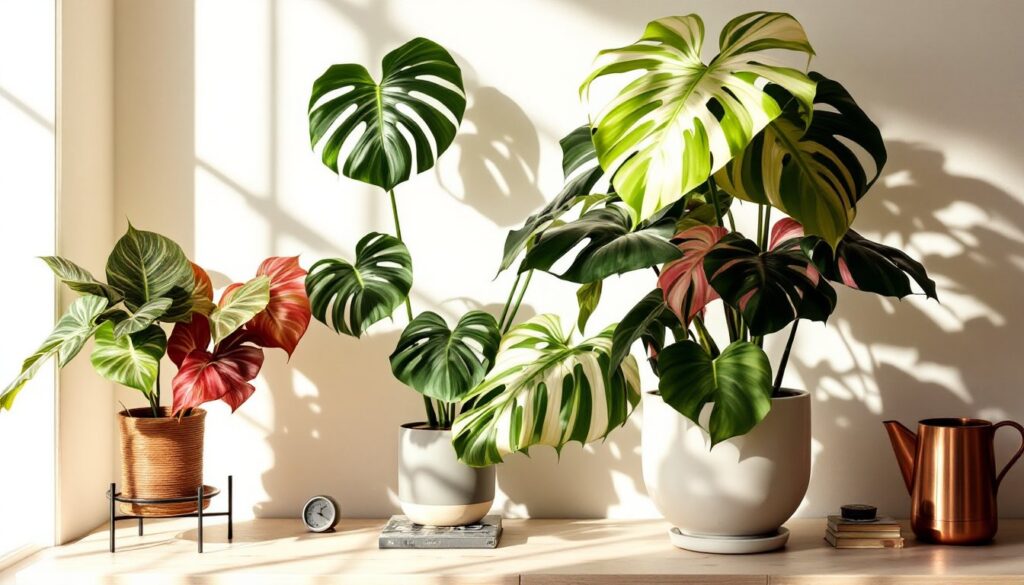
The Monstera ‘Albo’ is arguably the most recognized expensive house plant. Its dramatic white variegation against deep green leaves makes it instantly identifiable, and highly sought after.
Prices vary wildly depending on the size and variegation ratio. A rooted cutting with one or two leaves can run $200–$600. A mature plant with multiple fenestrated leaves and strong variegation? Expect $1,500–$3,000 or more.
What makes it expensive is the instability of the variegation. The white sectors lack chlorophyll, so the plant needs enough green to photosynthesize. Too much white, and the plant struggles. Too little, and it’s less visually striking. Growers can’t guarantee the variegation will continue in new growth, making each leaf a gamble.
Care requirements are moderate but specific. Provide bright, indirect light, too much sun burns the white sections, too little causes reversion to green. Use a well-draining potting mix (two parts peat or coco coir, one part perlite, one part orchid bark works well). Water when the top 2–3 inches of soil dry out.
Support is essential. Monsteras are climbers. Use a moss pole or wooden stake to encourage larger, more fenestrated leaves. The aerial roots will grab onto the support, mimicking their natural growth habit.
Humidity should stay between 60–80%. In dry climates, use a humidifier or place the pot on a pebble tray with water (don’t let the pot sit in water, it’ll rot the roots).
Be patient. Growth is slow, especially if variegation is heavy. Budget $15–30 monthly for fertilizer during the growing season (spring through early fall). Use a balanced liquid fertilizer diluted to half strength every two weeks.
This isn’t a beginner plant, but it’s not impossible either. Just be realistic about the time investment.
Philodendron ‘Pink Princess’: A Blushing Rare Find
The Philodendron ‘Pink Princess’ (PPP) became a viral sensation for its bubblegum-pink variegation on dark, glossy leaves. Prices peaked during the 2020 plant boom but have stabilized somewhat as more growers propagate it.
A small rooted cutting typically costs $100–$300. A fuller plant with multiple leaves and good pink variegation can run $400–$800. Plants with more pink than green are rarer and pricier, but also harder to keep alive.
The pink coloration is a genetic mutation. Like the Monstera ‘Albo’, it’s unstable. New leaves might come in all green, all pink (which will die without chlorophyll), or perfectly marbled. There’s no way to predict it.
Light is critical. Too little, and the plant reverts to green. Too much direct sun scorches the pink. Place it near an east-facing window or a few feet back from a south-facing one. If growing under lights, aim for 200–400 foot-candles (measured with a light meter app on your phone).
Soil and watering are standard for philodendrons. Use a chunky, airy mix, equal parts potting soil, perlite, and orchid bark. Water when the top 1–2 inches dry out. Overwatering is the fastest way to kill a PPP. Root rot sets in quickly.
Prune off all-green leaves if you want to encourage more variegation, though there’s no guarantee it’ll work. All-pink leaves should be removed immediately, they can’t sustain themselves and will drain energy from the plant.
PPPs are climbers. Provide a moss pole or trellis to encourage larger leaves. Fertilize monthly during the growing season with a balanced formula (10-10-10 or similar).
This plant rewards patience and attention. It’s not as forgiving as a pothos, but it’s far easier than an Anthurium.
Anthurium Warocqueanum (Queen Anthurium): Velvet Elegance
The Anthurium Warocqueanum, often called the Queen Anthurium, is a stunner. Its long, velvety leaves with prominent white veining can reach 3–4 feet in length on a mature plant. This isn’t a compact windowsill plant, it demands space and commitment.
Prices start around $300 for a juvenile plant and climb quickly. A specimen with multiple mature leaves can exceed $1,000. Availability is limited: most sales happen through specialty growers or online plant communities.
This species is native to Colombian rainforests and requires high humidity and warmth. It’s not for casual hobbyists. Many collectors who have explored high-value houseplants note that Anthuriums in this category require advanced care.
Humidity is non-negotiable. You’ll need 70–90% relative humidity, which usually means a greenhouse cabinet, grow tent, or dedicated plant room with a humidifier running constantly. Without it, the leaves develop brown edges and crisp up.
Temperature should stay between 65–80°F. Avoid drafts, cold windows, and temperature swings.
Light should be bright but filtered. Direct sun will scorch the velvety leaves. An east-facing window with sheer curtains works, or grow lights positioned 12–18 inches above the plant.
Watering is tricky. The plant likes consistent moisture but hates wet feet. Use a very chunky mix, 50% orchid bark, 30% perlite, 20% peat or coco coir. Water when the top inch just begins to dry. Underwatering causes leaf curling: overwatering causes root rot.
Fertilize every two weeks during active growth with a diluted liquid fertilizer. Use a formula with micronutrients to support those dramatic veins.
Expect to spend $30–50 monthly on humidifier water, electricity for grow lights, and fertilizer. This plant is high-maintenance, but the payoff is unmatched visual impact.
Alocasia Azlanii ‘Red Mambo’: The Metallic Showstopper
The Alocasia Azlanii, commonly sold as ‘Red Mambo’, is a newer hybrid that’s taken the plant world by storm. Its iridescent, copper-red leaves with metallic veining are unlike anything else in the Alocasia family.
Pricing has dropped as availability increased, but it’s still premium. Expect $150–$400 for a plant with 2–3 leaves. Larger specimens with 5+ leaves can hit $600–$800.
Growth habit is compact compared to other Alocasias, making it more apartment-friendly. Mature plants stay under 2 feet tall and wide.
Light requirements are moderate. Bright, indirect light brings out the metallic sheen. Too little light dulls the color. An unobstructed east window or a spot near a south window with a sheer curtain works well.
Watering follows the standard Alocasia rule: keep the soil lightly moist but never soggy. Use a well-draining mix, two parts potting soil, one part perlite, one part orchid bark. Water when the top 1 inch dries out. Alocasias are prone to root rot, so err on the side of slightly dry.
Humidity should be 60–80%. Lower humidity causes brown leaf edges. A humidifier or pebble tray helps, but don’t mist, it encourages fungal issues.
Alocasias go dormant in winter. Don’t panic if the plant drops leaves when daylight shortens. Reduce watering and stop fertilizing until new growth resumes in spring.
Pests are a concern. Spider mites love Alocasias. Inspect undersides of leaves weekly. If you spot webbing or stippling, treat immediately with insecticidal soap or neem oil.
This plant is more forgiving than the Anthurium but still requires attention. It’s a good middle ground for collectors stepping up from easy-care tropicals.
Caring for Your High-Value House Plants
Expensive plants demand expensive care, not in money necessarily, but in attention and consistency. Here’s what separates success from a $500 compost heap.
Start with the right environment. Don’t buy a high-humidity tropical if you live in Arizona and refuse to run a humidifier. Match the plant to your space, or modify your space to match the plant.
Invest in tools. A moisture meter ($10–15) takes the guesswork out of watering. A hygrometer ($8–12) monitors humidity. A light meter app (free) helps you dial in placement. These aren’t optional for expensive plants.
Quarantine new arrivals. Keep new plants away from your collection for 2–3 weeks. Inspect for pests, treat preemptively with neem oil or insecticidal soap, and monitor for issues before introducing them to other plants.
Repot carefully. Most expensive tropicals ship in nursery pots with dense, peat-heavy soil. Transition them to a chunkier mix within a month. Go up only 1–2 inches in pot diameter, oversized pots hold too much moisture and cause root rot.
Water quality matters. Tap water with high chlorine or fluoride can damage sensitive tropicals. Let tap water sit out overnight to off-gas chlorine, or use filtered water. Rainwater is ideal if you can collect it.
Fertilize during active growth only. Spring through early fall, feed every 2–4 weeks with a balanced liquid fertilizer at half strength. Stop fertilizing in late fall and winter unless the plant is actively growing under lights.
Prune strategically. Remove dead or dying leaves to prevent rot and pests. For variegated plants, prune all-green growth if you want to encourage variegation (though it’s not guaranteed).
Watch for pests. Spider mites, thrips, and mealybugs love expensive tropicals. Inspect weekly, especially new growth and leaf undersides. Treat infestations immediately, they spread fast. General home improvement resources like The Spruce offer pest identification guides if you’re unsure.
Be patient. High-value plants grow slowly. Rushing them with too much fertilizer or water causes more harm than good. Trust the process.
Conclusion
Expensive house plants aren’t for everyone, and that’s fine. They require time, attention, and a willingness to learn as you go. But for collectors who appreciate botanical rarity and are ready to invest in proper care, they offer something truly special. Start with one. Learn its rhythms. If it thrives, consider adding another. The investment, financial and otherwise, pays off when that first new leaf unfurls.