Keeping houseplants alive in dim corners or north-facing rooms can feel like a losing battle. Even the hardiest pothos starts to look leggy when starved for light, and forget about coaxing a fiddle leaf fig to thrive in a basement apartment. The solution isn’t moving, it’s supplemental lighting. With the right grow lights, nearly any space can support healthy, vibrant plants year-round, from seedlings to full-grown tropicals. This guide cuts through the marketing jargon and breaks down which lights actually work, how to match them to your plants’ needs, and what to buy without overspending.
Table of Contents
ToggleKey Takeaways
- Best lights for indoor plants include LED and fluorescent options, with LEDs offering superior energy efficiency and lifespan (50,000+ hours) despite higher upfront costs.
- Plants require specific light wavelengths—blue (400–500 nm) for foliage and red (600–700 nm) for flowering—which grow lights replicate to compensate for inadequate natural sunlight.
- Match light intensity to plant type: low-light plants need 100–200 μmol/m²/s, medium-light plants require 200–400 μmol/m²/s, and high-light species demand 400–600+ μmol/m²/s.
- Most houseplants thrive with 12–16 hours of daily light on a consistent timer, which regulates photoperiod and prevents growth mistakes from manual switching.
- Budget-friendly LED options like the GE BR30 bulb ($30–$50) suit casual plant owners, while serious growers benefit from higher-output panels like the Spider Farmer SF-1000 ($100–$200) for diverse collections.
- Distance matters: place LEDs 6–12 inches above plants and fluorescents 3–6 inches from foliage, adjusting height if leaves bleach or stems stretch toward the light source.
Why Your Indoor Plants Need Grow Lights
Plants don’t just want light, they need specific wavelengths to photosynthesize. Natural sunlight delivers a full spectrum, but most indoor spaces fall short. South-facing windows offer decent light for about six hours daily in winter: other orientations provide even less.
Without adequate light, plants stretch toward the nearest source (etiolation), producing weak, spindly growth. Leaves pale out, flowering plants refuse to bloom, and growth slows to a crawl. Even “low-light” species like snake plants or ZZ plants survive on minimal light but won’t actually thrive without supplemental help.
Grow lights solve this by delivering the blue wavelengths (400–500 nm) plants use for foliage growth and the red wavelengths (600–700 nm) that drive flowering and fruiting. Quality grow lights replicate the sun’s output at intensities and durations you control, effectively extending daylight or compensating for poor window exposure.
They’re essential if you’re starting seeds indoors, overwintering herbs, growing vegetables year-round, or keeping tropical plants happy in winter. Even decorative houseplants in low-light rooms benefit from 12–16 hours under a grow light, especially during the shorter days of fall and winter.
Types of Grow Lights for Indoor Plants
Two technologies dominate the residential grow light market: LEDs and fluorescents. Each has trade-offs in cost, efficiency, and application.
LED Grow Lights
LEDs (light-emitting diodes) have become the default choice for serious indoor gardeners. They emit very little heat, draw minimal electricity, and last 50,000+ hours, often a decade of daily use. Modern full-spectrum LEDs produce balanced blue and red wavelengths along with greens and yellows, resulting in a white or slightly purplish glow that’s easier on the eyes than the garish magenta of older “blurple” models.
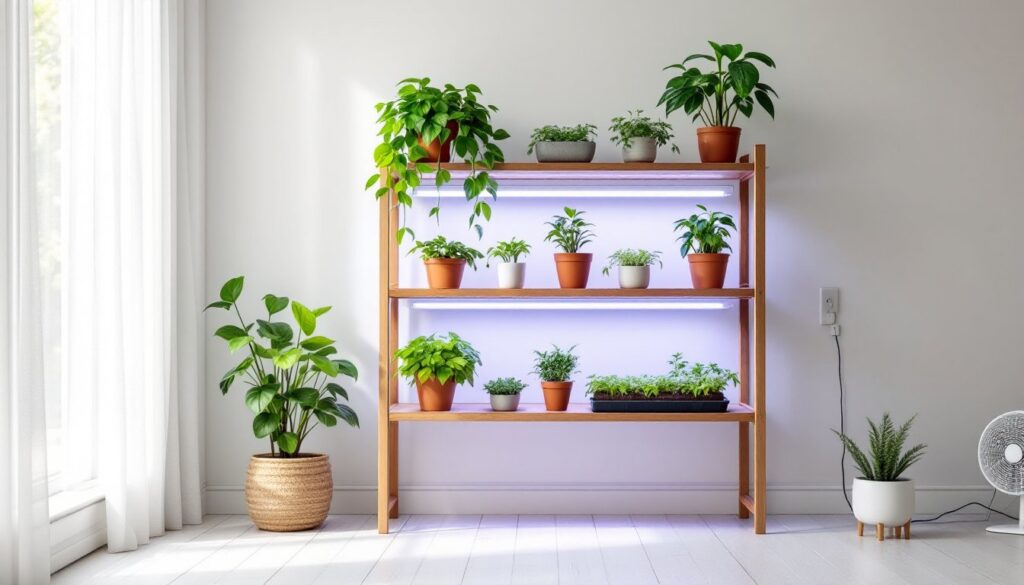
LEDs come in multiple form factors: screw-in bulbs for desk lamps, panel arrays for shelving units, and adjustable gooseneck fixtures for targeted lighting. They’re dimmable, often programmable via timers, and suitable for everything from a single succulent to a multi-tier propagation setup.
Downside: upfront cost. Quality LED grow lights start around $30 for a single bulb and climb past $200 for high-output panels. Bargain-bin LEDs from unknown brands often underperform their specs and fail early. Stick with manufacturers that publish PAR (photosynthetically active radiation) or PPFD (photosynthetic photon flux density) ratings, these measure actual usable light, not just lumens.
Fluorescent Grow Lights
Fluorescent tubes (T5, T8) and compact fluorescent lamps (CFLs) remain a budget-friendly option, especially for seedlings, herbs, and low-light foliage plants. T5 fixtures produce strong output in the blue spectrum, ideal for leafy greens and young plants. They run cooler than incandescent bulbs but warmer than LEDs, and they need replacing every 10,000–20,000 hours as output degrades.
Fluorescents work well in tight spaces, T5 strips fit neatly under shelves or inside grow tents. They’re plug-and-play with minimal setup, and replacement tubes cost less than $10. But, they’re less energy-efficient than LEDs and lack the red spectrum punch needed for flowering plants unless you buy specialized “full-spectrum” tubes.
For hobbyists starting seeds or maintaining a small herb garden on a kitchen shelf, fluorescent fixtures from trusted retailers offer a low-risk entry point. If you’re scaling up or growing light-hungry species like tomatoes or orchids, LEDs deliver better long-term value.
How to Choose the Right Grow Light for Your Plants
Matching light to plant needs requires understanding three variables: intensity, spectrum, and duration.
Intensity is measured in foot-candles or PPFD. Low-light plants (pothos, philodendron) thrive with 100–200 μmol/m²/s. Medium-light plants (ferns, most tropicals) want 200–400 μmol/m²/s. High-light species (succulents, fruiting vegetables) need 400–600+ μmol/m²/s. Most consumer LED panels deliver 200–300 μmol/m²/s at 12 inches, so plan fixture height and coverage area accordingly.
Spectrum matters less with modern full-spectrum LEDs, which blend blue, red, and white diodes. For foliage-only plants, a cooler (5000–6500K) white LED works fine. Flowering and fruiting plants benefit from lights with boosted red output (3000–4000K) or dedicated bloom switches. Avoid single-color lights unless you’re experimenting, plants use multiple wavelengths, and narrow-spectrum lighting can stunt growth.
Duration depends on species. Most houseplants do well with 12–16 hours of light daily. Seedlings and leafy greens can handle 16–18 hours. Flowering plants often need a photoperiod shift, long days to vegetate, shorter days (12 hours) to trigger blooming. Use a timer to maintain consistency: plants respond to regular light cycles, and manual switching invites mistakes.
Distance from canopy to light affects intensity and heat. LEDs can sit 6–12 inches above plants without burning. Fluorescents should stay 3–6 inches from foliage. If leaves bleach or curl, raise the light. If stems stretch, lower it.
Coverage area scales with fixture wattage and design. A 20W LED bulb covers roughly one square foot. A 50W panel handles 2–3 square feet. Multi-tier shelving or large plant collections require multiple fixtures or higher-wattage panels (100W+). Manufacturers often exaggerate coverage, cut their claims by 25% for realistic estimates.
Finally, consider your space’s ambient conditions. Plants under grow lights may need more frequent watering due to increased photosynthesis. Rooms with poor air circulation risk mold or weak stems: a small fan helps. And if you’re growing edibles indoors, remember that some crops (tomatoes, peppers) need hand-pollination or a fan to simulate wind and encourage fruit set.
Top Grow Light Recommendations for Every Budget
Under $50: GE BR30 LED Grow Light Bulb
This screw-in bulb fits standard lamps and delivers balanced full-spectrum output for 1–2 small plants. It’s rated at 9W actual draw (45W equivalent), outputs around 150 μmol/m²/s at 12 inches, and works great for herbs, seedlings, or a single pothos. No dedicated fixture required, just swap it into any table lamp. Lifespan is rated at 25,000 hours. Best for: casual plant owners with one or two pots.
$50–$100: Barrina T5 LED Grow Light (4-Pack)
These linkable 2-foot LED strips mount under shelves with included clips and hardware. Each tube draws 20W, and the four-pack covers about 4 square feet. Full-spectrum white light is easy on the eyes, and the daisy-chain design lets you power multiple strips from one outlet. They come with a plug-in timer and deliver consistent output for leafy greens, herbs, and propagation trays. Best for: shelving setups and seed-starting operations.
$100–$200: Spider Farmer SF-1000 LED Panel
A 100W quantum board with Samsung diodes and a Meanwell driver, this fixture delivers 300+ μmol/m²/s over a 2×2-foot area. It’s dimmable, runs whisper-quiet (fanless), and handles everything from seedlings to flowering plants. The full-spectrum white light includes enhanced red, making it suitable for vegetables, herbs, and ornamentals. Mounting hardware is included: hang it from shelving or a grow tent frame. Best for: serious hobbyists and small indoor gardens.
$200+: Mars Hydro TS 3000
This 450W panel covers a 4×4-foot vegetative footprint or 3×3 for flowering, delivering 700+ μmol/m²/s at canopy level. It features high-efficiency Samsung LM301B diodes and an aluminum heat sink, keeping temps manageable without a fan. Daisy-chain capability and a dimmer knob offer flexibility for multi-light setups. It’s overkill for a few houseplants but ideal if you’re growing fruiting crops (tomatoes, peppers) or maintaining a diverse indoor collection. Best for: dedicated grow rooms and year-round food production.
Specialty Option: Soltech Solutions Aspect Pendant
If aesthetics matter, this $150 hanging pendant delivers full-spectrum LED output in a sleek, designer-friendly housing. It’s rated for a 2-foot coverage area and looks at home in a living room or dining space. Output is lower than utilitarian panels, so it’s best for medium-light plants (ferns, prayer plants) rather than high-light species. Best for: decorative installations where the light fixture doubles as interior decor.
When shopping, verify the fixture’s actual wattage (not “equivalent” claims), check for thermal management (heat sinks, fans), and look for a warranty of at least one year. For further inspiration on pairing lights with specific plant species, consider how different varieties respond to intensity and spectrum shifts.
Conclusion
Supplemental lighting transforms dim spaces into thriving indoor gardens. Whether you’re nursing a single fern or cultivating a shelf full of seedlings, the right grow light delivers the spectrum, intensity, and duration plants need to grow strong and healthy. Start with your plant’s light requirements, match them to fixture specs, and don’t skip the timer, it’s the cheapest tool in your setup and the most important for consistent results.