Plants don’t care about your basement apartment’s lack of natural light, they just want photosynthesis. If you’re trying to keep fiddle-leaf figs alive in a north-facing room or start seedlings in February, indoor grow lights bridge the gap between what the sun provides and what your plants actually need. Not all grow lights are created equal, though. The wrong spectrum can leave seedlings leggy, and underpowered fixtures won’t support flowering plants. This guide breaks down the types, features, and practical setup tips to help anyone, whether they’re nursing a single pothos or running a shelf full of African violets, choose the right grow light and use it effectively.
Table of Contents
ToggleKey Takeaways
- LED grow lights are the most energy-efficient option for indoor plants, using 50 watts to deliver the light output of a 150-watt incandescent bulb while lasting 50,000+ hours.
- Indoor grow lights work by delivering targeted blue light (400–500 nm) for vegetative growth and red light (600–700 nm) for flowering, replacing the full spectrum that natural sunlight provides.
- Most houseplants thrive on 12–16 hours of daily light paired with proper intensity: low-light plants need 100–200 foot-candles, while high-light plants like succulents demand 400–800+ foot-candles.
- Fluorescent T5 grow lights are an affordable entry point for beginners and seedlings, costing $15–$50 per fixture, though they require closer placement (2–4 inches) than LEDs.
- Light intensity drops 75% when you double the distance between fixture and plant, so proper height adjustment and reflective surfaces are critical for maximizing growth.
- Pair your best indoor grow lights with a simple timer set for 12–16 hours daily and ensure adequate ventilation to prevent mold and promote strong, healthy plant development.
Why Indoor Grow Lights Matter for Healthy Houseplants
Natural sunlight delivers a full spectrum of wavelengths that plants convert into energy. Indoors, even bright rooms rarely provide enough intensity or the right spectrum, especially in winter when daylight hours shrink. Plants respond predictably: they stretch toward weak light (etiolation), drop leaves, or stop flowering altogether.
Grow lights replicate the sun’s spectrum using targeted wavelengths. Blue light (400–500 nm) drives vegetative growth and compact foliage. Red light (600–700 nm) triggers flowering and fruiting. Full-spectrum bulbs combine both, plus green and white light for balanced development.
Intensity matters as much as spectrum. Foot-candles measure light output, and most houseplants need 200–400 foot-candles for maintenance, while high-light plants like succulents or tomatoes demand 1,000+ foot-candles. A south-facing window might deliver 5,000 foot-candles at midday, but move 3 feet back and that drops to 500. Grow lights let homeowners control both intensity and duration, compensating for seasonal changes or windowless spaces.
Photoperiod, how long plants receive light, also affects growth. Most houseplants thrive on 12–16 hours of light daily. Without enough, plants can’t photosynthesize enough sugars to fuel growth. Too much can stress them. Timers make consistent photoperiods simple, which is critical for seedlings and blooming plants like orchids.
Types of Indoor Grow Lights Explained
Choosing the right grow light type depends on budget, plant needs, and energy costs. Here are the two most practical options for home growers.
LED Grow Lights: Energy-Efficient and Versatile
LED (light-emitting diode) grow lights dominate the market for good reason. They deliver targeted wavelengths with minimal heat and excellent energy efficiency. A 50-watt LED can replace a 150-watt incandescent bulb while producing more usable light for plants.
LEDs come in several configurations:
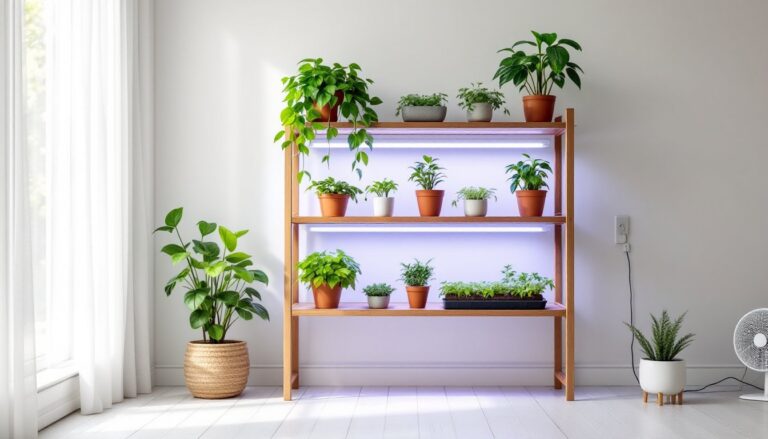
- Full-spectrum panels: Mimic sunlight with balanced blue, red, and white light. They work for all growth stages and multiple plant types. Look for panels rated at least 50 watts actual draw (not “equivalent”) for a 2×2-foot growing area.
- Purple/red-blue lights: Older LED designs emphasize red and blue diodes, giving off a magenta glow. They’re effective but can make it hard to spot pests or nutrient deficiencies under that unnatural light.
- White-spectrum LEDs: Newer models use white diodes that include the full spectrum. They’re easier on the eyes and still provide the wavelengths plants need.
LEDs run cool enough to place 6–12 inches above foliage without scorching leaves, and they last 50,000+ hours, years of daily use. Upfront costs are higher ($40–$200+ depending on wattage and features), but energy savings add up. A 100-watt LED running 14 hours daily costs roughly $4–$6 per month in electricity, compared to $12–$18 for equivalent HID lighting.
Many LED fixtures include dimming, timers, and daisy-chaining for multi-shelf setups. If growing anything beyond low-light pothos, LEDs are the most versatile choice.
Fluorescent Grow Lights: Budget-Friendly for Beginners
Fluorescent lights, especially T5 and T8 tubes, are the go-to for budget-conscious growers and seedling starts. They’re widely available, affordable ($15–$50 for a fixture), and produce low heat.
T5 fluorescent tubes (5/8-inch diameter) are more efficient than older T12 bulbs and fit standard shop-light fixtures. A two-tube, 2-foot fixture draws about 24 watts and covers seedling trays or a small herb garden. For comparison, T8 tubes (1-inch diameter) are slightly less efficient but still effective.
Fluorescents emit a cooler spectrum, heavier on blue wavelengths, which makes them ideal for leafy greens, herbs, and seedlings. They’re less effective for flowering or fruiting plants unless you choose “full-spectrum” or “grow” labeled bulbs that add red wavelengths.
Place fluorescent tubes 2–4 inches above plants, they don’t generate enough intensity to penetrate deep canopies, so proximity is key. Tubes lose output over time: replace them every 12–18 months even if they still glow.
Fluorescents work well for hobbyists starting seeds in a basement or supplementing light for African violets on a bookshelf. They won’t support a citrus tree or cannabis, but for low- to medium-light plants, they’re a solid entry point.
Top Features to Look for When Choosing Grow Lights
Not every grow light suits every situation. Focus on these features to match a fixture to the plants and space.
Wattage and actual draw: Manufacturers often list “equivalent” wattage, which is meaningless for grow lights. Check the actual power draw in watts. For LEDs, plan 25–50 watts per square foot for high-light plants, 15–25 watts for medium-light plants. Fluorescents need higher wattage per square foot due to lower efficiency.
PAR (photosynthetically active radiation): This measures light in the 400–700 nm range that plants actually use. Quality LEDs provide PAR output ratings in μmol/m²/s. Seedlings and herbs need 200–400 μmol/m²/s: flowering plants need 400–600+. Not all fixtures list PAR, but it’s the most accurate indicator of grow light performance.
Adjustability: Look for lights with dimmable output or adjustable height. Seedlings need lower intensity than mature plants, and recommendations on light placement emphasize flexibility for different growth stages. Fixtures with hanging kits or telescoping stands let users fine-tune distance as plants grow.
Heat output: LEDs run coolest, but even they generate some heat. If growing in a closet or cabinet, ensure adequate ventilation. Fluorescents produce moderate heat: keep them close but not touching foliage. HID lights (metal halide, HPS) run very hot and usually aren’t practical for home use.
Timer compatibility: Consistent photoperiods matter. Built-in timers are convenient, but any fixture can work with a plug-in mechanical or digital timer ($10–$20). Set it and forget it.
Coverage area: Manufacturers list coverage at different heights, typically both vegetative (18–24 inches) and flowering (12–18 inches) stages. A panel that covers 4×4 feet at 24 inches might only cover 2×2 feet at 12 inches. Match coverage to the footprint of shelves or growing areas.
Spectrum customization: High-end LEDs offer separate channels for blue, red, and white light. Most home growers don’t need this, but if growing multiple plant types with different needs, it’s a nice option.
How to Match Grow Lights to Your Plant Types
Different plants have different light appetites. Here’s how to pair the right grow light with common indoor plants.
Low-light plants (pothos, snake plants, philodendrons): These tolerate dim conditions but still grow better with supplemental light. A basic LED bulb (9–15 watts) in a desk lamp or a single T5 fluorescent tube 12–18 inches above provides enough light. Aim for 100–200 foot-candles, or roughly 100–200 μmol/m²/s PAR. Run lights 10–12 hours daily.
Medium-light plants (ferns, most tropical houseplants, African violets): These need brighter, more consistent light. A 20–40-watt LED panel or a two-tube T5 fixture works well. Position lights 6–12 inches above foliage and provide 12–14 hours of light. Target 200–400 foot-candles.
High-light plants (succulents, cacti, citrus, fiddle-leaf figs): These demand intense light similar to full sun. Use a 50–100-watt full-spectrum LED panel or multiple T5 tubes. Place LEDs 6–12 inches above, fluorescents 2–4 inches above. Provide 14–16 hours of light and aim for 400–800+ foot-candles or 400–600 μmol/m²/s PAR.
Flowering and fruiting plants (tomatoes, peppers, orchids in bloom): Red spectrum drives flowering. Full-spectrum LEDs with strong red output (look for 3000–3500K color temperature plus red diodes) are ideal. These plants need high intensity, at least 600 μmol/m²/s PAR, and 12–16 hours of light depending on the species. Orchids, for example, often need a cooler period with reduced light to trigger blooming.
Seedlings and propagation: Young plants need gentle, full-spectrum light to prevent stretching. A T5 fluorescent or a low-wattage LED (20–30 watts) positioned 2–4 inches above trays works perfectly. Gradually increase intensity as seedlings develop true leaves. Give them 14–16 hours of light daily.
When comparing options, expert reviews on spectrum and performance can help narrow choices based on specific plant needs.
Placement and Setup Tips for Maximum Growth
Even the best grow light won’t deliver results if it’s positioned poorly. Follow these setup guidelines to maximize effectiveness.
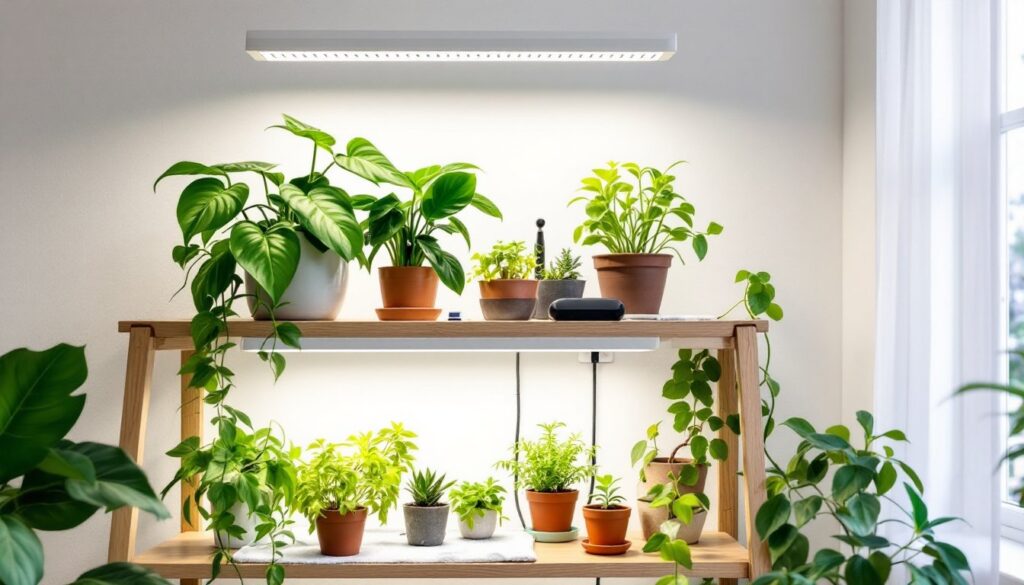
Measure and adjust height: Light intensity drops rapidly with distance. Doubling the distance between light and plant reduces intensity by roughly 75%. Use the fixture’s recommended height as a starting point, then watch plants for signs: leaves curling or bleaching mean the light’s too close: stretching or pale growth means it’s too far. For LEDs, start at 12–18 inches and adjust. For fluorescents, start at 2–4 inches.
Use reflective surfaces: White walls, aluminum foil, or reflective Mylar sheets bounce stray light back onto plants, increasing efficiency by 10–20%. Line shelves or closets with reflective material to maximize coverage, especially if growing on open racks.
Rotate plants regularly: Light intensity is strongest directly under the fixture. Rotate plants every few days so all sides receive even exposure, preventing lopsided growth.
Install timers for consistency: Plants respond to regular photoperiods. A $12 mechanical timer ensures lights turn on and off at the same time daily. Set 12–16 hours depending on plant type. Don’t give plants 24-hour light, they need a dark period for respiration and metabolic processes.
Ventilate enclosed spaces: Even cool-running LEDs raise ambient temperature in closets or cabinets. A small clip-on fan ($15–$25) improves air circulation, prevents mold, and strengthens stems through gentle movement. If growing in a closed cabinet, crack the door or add passive vents.
Combine with natural light when possible: Grow lights work best as a supplement, not a replacement, for natural sunlight. Place plants near windows and use grow lights to extend day length or boost intensity during cloudy periods. This hybrid approach saves energy and keeps monthly electric costs down.
Monitor plant response: Healthy growth is the best indicator of proper lighting. Dark green, compact foliage with strong stems means the setup is working. Leggy, pale, or slow growth signals insufficient light. Leaf burn or curling indicates too much intensity or heat. Adjust height, duration, or wattage accordingly.
Safety note: Always use grow lights rated for damp or wet locations if watering near the fixture. Keep cords and timers away from water sources. Check that electrical circuits can handle the total wattage, most home circuits support 15–20 amps (1,800–2,400 watts), but don’t max them out. If running multiple high-wattage fixtures, spread them across circuits.
For deeper guidance on plant care beyond lighting, comprehensive gardening resources cover everything from soil prep to pest management.
With the right grow light properly positioned, even the darkest corner can support lush, healthy plants year-round.