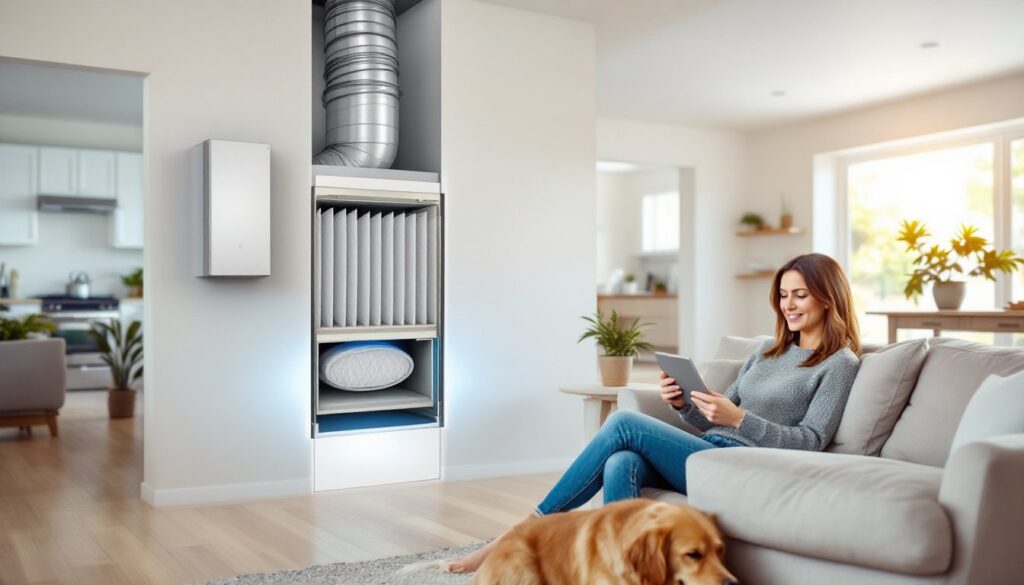
Indoor air can harbor five times more pollutants than outdoor air, according to the EPA, dust mites, pet dander, mold spores, VOCs from furniture, and particulates from cooking all accumulate in tightly sealed modern homes. Portable air purifiers handle single rooms, but they’re a patchwork solution. Whole-house air purifiers integrate with existing HVAC systems or operate as standalone units to clean every cubic foot of air circulating through a home. This guide covers the best whole-house air purifier systems for 2026, how they compare to portable models, and what homeowners need to know before installation.
Table of Contents
ToggleKey Takeaways
- Whole-house air purifiers process 1,000–2,000 CFM compared to 200–400 CFM for portable units, providing consistent coverage for entire homes and eliminating the need for multiple devices.
- Choose a best air purifier for whole house with MERV 11–13 filters for general air quality or MERV 14–16 for allergy and asthma management, avoiding “HEPA-type” marketing claims.
- Size your system by calculating total cubic footage and desired air changes per hour (ACH); a 2,000 sq. ft. home requires approximately 1,067 CFM at 4 ACH for effective allergy management.
- HVAC-integrated systems cost $1,000–$2,000 installed and rely on existing furnace blowers, while standalone units ($3,000+) suit homes without central HVAC or extreme filtration needs.
- Plan for annual filter replacement costs of $40–$100 for pleated filters and $50–$100 for UV bulbs, plus potential energy increases of $6–$18/month if running the blower continuously.
- Verify your furnace blower’s CFM rating can handle the filter’s pressure drop before installation to prevent airflow restriction, overheating, or AC coil freezing.
Why Whole-House Air Purifiers Beat Portable Units
Whole-house systems treat air at the source, either in the return duct of a forced-air HVAC system or through a centralized filtration unit that processes air continuously. Portable units are limited by room size (typically 300–500 sq. ft. per unit) and require strategic placement to avoid dead zones where air doesn’t circulate.
The biggest advantage is consistent coverage. A whole-house system filters air every time the furnace or AC blower runs, treating the entire home without needing multiple devices running in different rooms. For homes with central HVAC, this means one filter media change instead of juggling four or five portable units.
Whole-house systems also handle higher airflow volumes. HVAC-integrated models process 1,000–2,000 cubic feet per minute (CFM), compared to 200–400 CFM for most portables. That throughput matters in homes with pets, smokers, or chronic allergy sufferers where contaminant load is high.
Portable units make sense for renters or spot treatment (a nursery, home office, or bedroom), but they don’t address pollutants in hallways, basements, or kitchens unless you buy enough units to blanket the home, at which point cost and maintenance effort exceed a single whole-house system.
Key Features to Look for in a Whole-House Air Purifier
Not all whole-house systems are equal. The most critical factors are filtration technology, compatibility with existing HVAC infrastructure, and system capacity relative to home size.
Filtration media determines what the system can capture. Mechanical filters (pleated or HEPA-grade) trap particles. Activated carbon filters adsorb odors, VOCs, and gases. UV-C lights kill bacteria and mold spores but don’t remove particulates. The best systems use multi-stage filtration: a pre-filter for large debris, a high-efficiency particulate filter, and a carbon or UV stage for chemical and biological contaminants.
System compatibility matters for HVAC-integrated models. Most retrofit into existing ductwork, but older furnaces with low blower capacity may struggle with the added static pressure from dense filters. Check the furnace blower’s rated CFM and ensure it can handle the filter’s pressure drop (measured in inches of water column, or “w.c.”).
Airflow capacity should match home size. Calculate total square footage (including basements and finished attics) and aim for a system rated to handle that area with adequate air changes per hour (ACH). For allergy or asthma management, target 4–6 ACH: for general air quality, 2–4 ACH is sufficient.
Filtration Technology and MERV Ratings
MERV (Minimum Efficiency Reporting Value) ratings run from 1 to 20, with higher numbers indicating finer filtration. Standard fiberglass furnace filters are MERV 1–4 and catch only large dust. For whole-house purification, look for MERV 11–13 filters, which capture pollen, mold spores, and pet dander without choking airflow in most residential HVAC systems.
MERV 14–16 filters approach HEPA performance (HEPA is roughly equivalent to MERV 17–20) and trap smoke, bacteria, and particles as small as 0.3 microns. These require stronger blower motors and aren’t compatible with all furnaces, check your system’s manual or consult an HVAC tech before upgrading past MERV 13.
True HEPA filters capture 99.97% of particles at 0.3 microns but add significant static pressure. Whole-house HEPA systems are typically standalone units with their own fans, not retrofit filters. They’re overkill for most homes unless someone has severe respiratory conditions.
Avoid filters claiming “HEPA-type” or “HEPA-like”, these are marketing terms with no standardized performance threshold.
Top Whole-House Air Purifier Systems for 2026
Several systems dominate the 2026 market, balancing filtration performance, ease of installation, and ongoing costs.
Aprilaire 5000 is a popular HVAC-integrated option with a MERV 16 filter and electronic media that creates an electrostatic charge to capture sub-micron particles. It’s designed for homes up to 3,000 sq. ft. and installs in the return duct. Filter replacement is once a year under typical use. Expect around $1,000–$1,200 for the unit plus $150–$300 for professional installation if ductwork modifications are needed.
Lennox PureAir™ combines MERV 16 filtration with a UV-C light and a carbon filter for VOCs. It integrates directly with Lennox HVAC systems and treats homes up to 4,000 sq. ft. It’s one of the few systems independently tested to remove over 90% of ozone, formaldehyde, and other gases. Installation typically requires an HVAC pro and costs $1,500–$2,000 all-in.
Honeywell F300E1001 is a budget-friendly electronic air cleaner using washable media, no disposable filters. It captures particles down to 0.3 microns and works in homes up to 2,000 sq. ft. The upfront cost is lower ($600–$800 installed), but it doesn’t address gases or odors, so pair it with a carbon filter if needed.
For homes without forced-air HVAC, the IQAir Perfect 16 is a standalone system with HyperHEPA filtration rated for particles down to 0.003 microns. It’s a large cabinet unit with its own fan and ductwork, capable of treating homes up to 3,500 sq. ft. Cost is steep, $3,000+, but it’s the gold standard for severe allergies or immune-compromised occupants.
Many independent evaluations show HVAC-integrated systems outperform portable units in multi-room coverage and particle reduction over extended run times.
Installation Options: HVAC Integration vs. Standalone Systems
HVAC-integrated systems mount in the return air duct, upstream of the furnace or air handler. Installation involves cutting into sheet metal ductwork, mounting the filter cabinet, and running power if the unit requires electricity (electronic filters and UV lights do: passive filters don’t). Most homeowners hire an HVAC tech for this, expect 2–4 hours of labor. DIY is possible if you’re comfortable with sheet metal snips, foil tape, and basic electrical (120V), but improper sealing or placement can reduce system efficiency.
These systems rely on the furnace blower, so they only filter air when the HVAC is running. Many homeowners set the thermostat fan to “on” instead of “auto” to maintain continuous filtration, which increases energy use by 50–100 kWh/month depending on blower motor efficiency. ECM (electronically commutated motor) blowers are more efficient for continuous operation.
Standalone whole-house systems are self-contained units with their own fans and ductwork. They’re either mounted in a basement or utility room with duct runs to pull air from multiple zones, or they’re bypass systems that tie into existing ductwork but don’t depend on the furnace blower. Installation is more involved, figure on a full day and potentially new duct runs if the home layout is complex.
Standalone units make sense in homes without central HVAC (those using baseboard heat or mini-splits) or where the existing HVAC system can’t handle the added load of high-MERV filtration. They’re also a fit for extreme filtration needs (HEPA or better) that exceed what a standard furnace blower can support.
Neither option requires a permit in most jurisdictions unless you’re significantly altering ductwork or running new electrical circuits. Always check local building codes.
Maintenance Requirements and Long-Term Costs
Ongoing costs center on filter replacement and energy consumption. HVAC-integrated systems with pleated or electronic media require annual filter changes costing $40–$100 per filter, depending on brand and MERV rating. Carbon filters last 6–12 months and run $50–$80. UV bulbs degrade over time and need replacement every 1–2 years at $50–$100 per bulb.
Washable electronic filters (like the Honeywell F300) eliminate disposable media costs but require cleaning every 1–3 months. Pull the filter cells, rinse with a hose or soak in a tub with mild detergent, air dry completely, then reinstall. Skip the dishwasher, high heat can warp the media.
Standalone HEPA systems have higher media costs because true HEPA filters are dense and expensive. Expect $100–$200 per filter annually, plus pre-filters every 3–6 months at $20–$40.
Energy use varies by system. HVAC-integrated systems piggyback on the furnace blower, adding minimal energy draw (maybe 10–20 watts for electronic filters or UV lights). Running the blower continuously to maintain filtration adds 50–150 kWh/month, or $6–$18 depending on electricity rates. Standalone units with dedicated fans consume 50–200 watts depending on fan speed, call it $5–$15/month at typical runtime.
Comparison testing featured in whole-house air purifier reviews consistently highlights filter replacement as the primary cost driver, so factor media prices before committing to a system.
How to Choose the Right System for Your Home Size
Start with total conditioned square footage, the sum of all heated and cooled spaces, including finished basements and bonus rooms. Multiply by ceiling height (typically 8 ft.) to get cubic footage, then factor in desired air changes per hour.
For a 2,000 sq. ft. home with 8 ft. ceilings:
- Total volume = 2,000 × 8 = 16,000 cubic feet
- At 4 ACH (good for allergy management): 16,000 × 4 = 64,000 cubic feet per hour
- Divide by 60 to get CFM: 64,000 ÷ 60 ≈ 1,067 CFM
Match that CFM to a system’s rated capacity. Most HVAC blowers in residential systems run 800–1,600 CFM, so a 2,000 sq. ft. home is well within range for a standard HVAC-integrated purifier. Larger homes (3,000+ sq. ft.) may need a higher-capacity system or a standalone unit with a dedicated fan.
If your HVAC system’s blower is undersized or older, installing a high-MERV filter can restrict airflow, causing the furnace to overheat or the AC coil to freeze. Check the blower’s CFM rating (on the furnace data plate or in the manual) and ensure it exceeds the calculated requirement by at least 10–15%.
For homes with zoned HVAC, a single whole-house purifier in the main return duct may not treat closed-off zones effectively. In that case, consider per-zone filtration or a standalone system with duct runs to each zone.
Various guides, including those covering whole-home air purification systems, emphasize sizing as a critical factor, undersized systems run continuously without achieving target ACH, while oversized systems cycle inefficiently and waste energy.