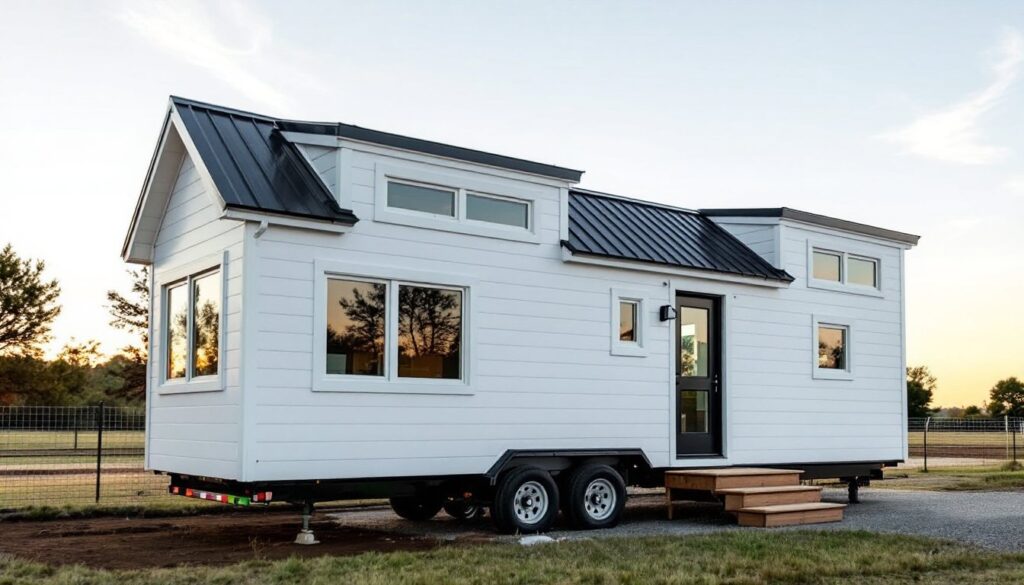
A 14×32 tiny house delivers 448 square feet of living space, enough room for a full kitchen, bathroom, bedroom, and living area without the bloat of a traditional home. This footprint hits a sweet spot: it’s large enough to avoid feeling cramped, yet compact enough to sidestep many zoning restrictions that plague smaller builds. Whether you’re looking to downsize, build a backyard ADU, or create a primary residence on a budget, the 14×32 dimension offers flexibility that works on standard trailer frames or permanent foundations. This guide walks through design strategies, code requirements, realistic costs, and layout tricks to help you plan and execute a build that maximizes every square inch.
Table of Contents
ToggleKey Takeaways
- A 14×32 tiny house delivers 448 square feet of living space, striking the ideal balance between comfort and affordability while meeting financing and insurance requirements that smaller builds often can’t achieve.
- The 14-foot width aligns with standard road-legal trailer dimensions and simplifies foundation framing, while the 32-foot length allows separate living zones without excess hallways or forced compromises.
- Design your 14×32 for 10-foot ceilings, place windows on at least three walls for cross-ventilation, and use vertical storage and pocket doors to maximize usable space without cramped sensations.
- Building costs range from $30,000–$60,000 for DIY projects to $60,000–$100,000+ with hired labor; foundation or trailer costs, framing, insulation, plumbing, and electrical work are the largest budget items.
- Zoning and permit requirements vary significantly by jurisdiction—many municipalities restrict tiny homes as primary residences but allow them as Accessory Dwelling Units (ADUs), so verify local codes before breaking ground.
- Light colors, appropriately scaled furniture, multi-function spaces, and strategic visual boundaries transform 448 square feet into a home that feels spacious and livable for the long term.
Why the 14×32 Footprint Is Perfect for Tiny Living
The 14-foot width aligns with standard road-legal trailer dimensions, making this size ideal for RTHA (Recreational Park Trailer) or towable tiny homes. If you’re building on a foundation, 14 feet keeps framing straightforward, floor joists can span that width with common 2×10 or 2×12 lumber at 16-inch centers without requiring a central beam.
At 32 feet long, you get enough linear footage to separate living zones without hallways eating up space. Compare that to a 10×20 or 12×24 build, where every square foot forces painful compromises. With 448 square feet, you can fit a queen bed, a soaking tub, and a real dining table, not murphy beds and composting toilets by default (though those are still options).
This dimension also skirts many minimum square footage requirements for permanent dwellings. Some jurisdictions set 400 sq ft as the threshold for habitable structures, and 448 puts you comfortably above that line. It’s large enough to qualify for financing and insurance in many areas, unlike ultra-compact builds under 300 square feet that lenders won’t touch.
Essential Design Considerations for Your 14×32 Tiny House
Start with ceiling height. For a tiny house on wheels, you’re capped at 13’6″ total height for road clearance. That leaves roughly 9 to 10 feet of interior ceiling after accounting for trailer deck, floor framing, and roofing. If you’re building on a foundation, push for 10-foot ceilings in the main living area, it makes 448 square feet feel twice as large.
Window placement matters more in tiny homes than traditional builds. Plan for windows on at least three walls to create cross-ventilation and avoid the cave effect. Casement or awning windows work better than double-hung in tight spaces, they don’t eat countertop or furniture clearance when open.
Roof pitch affects both interior volume and exterior aesthetics. A 5/12 or 6/12 pitch provides enough slope for metal roofing or asphalt shingles while creating usable loft space. Anything steeper adds unnecessary height: anything shallower risks water pooling and limits attic storage.
Don’t skip moisture management. Tiny homes have less air volume to dilute humidity from cooking, showering, and breathing. Install a ventilation fan rated for at least 50 CFM in the bathroom, and consider a heat recovery ventilator (HRV) if you’re in a cold climate. Closed-cell spray foam insulation helps with vapor barriers, but it’s pricey, R-21 fiberglass batts with careful air sealing work fine if you’re on a budget.
Maximizing Space with Smart Floor Plan Layouts
The classic tiny house layout puts the kitchen and bathroom along one long wall, with plumbing stacked to simplify rough-ins. This leaves the opposite wall open for windows and living space. In a 14×32, you can flip that script: place the bathroom in the middle of the floor plan as a divider between the bedroom and living area. This creates two distinct zones and gives you privacy without adding walls that chop up sightlines.
Open shelving beats upper cabinets in kitchens. It keeps the space from feeling closed-in and forces you to stay organized. Plan for a 30-inch-wide countertop run minimum for prep space, anything less makes cooking frustrating. A 24-inch-deep counter works, but 25 or 26 inches lets you fit a standard undermount sink without the basin hanging over the cabinet face.
Builders often overlook small space living ideas that make narrow footprints feel open. Skip interior doors where privacy isn’t essential, use a pocket door or barn door for the bathroom, and leave the bedroom entry open or hung with a curtain. Each swinging door eats 10 to 12 square feet of floor space when you account for clearance.
Vertical storage is non-negotiable. Install floor-to-ceiling shelving in closets, add hooks along walls for bikes or coats, and use the space above doorways for shallow cabinets. A loft bedroom frees up the main floor, but make sure you have at least 42 inches of headroom up there, anything less feels like a coffin.
Building Codes and Zoning Requirements for 14×32 Structures
Code compliance depends on whether you’re building a tiny house on wheels (THOW) or a permanent foundation. A THOW typically falls under ANSI A119.5 (Recreational Park Trailer standard), not the International Residential Code (IRC). That means different rules for egress, stairs, and loft ladders. You’ll need RV certification from RVIA or NOAH to legally park and insure it in most states.
For foundation builds, the IRC applies. Your 14×32 must meet minimum room dimensions: habitable rooms need at least 70 square feet with no dimension less than 7 feet. Your 14-foot width clears that easily. Ceiling height must be at least 7 feet for habitable space, though kitchens and bathrooms can drop to 6’8″ under beams.
Egress windows are mandatory in bedrooms. You need one window with a minimum 5.7 square feet of clear opening, no more than 44 inches above the floor, and at least 20 inches wide and 24 inches tall. Loft bedrooms are tricky, some jurisdictions allow ships ladders or alternating tread stairs, others require full-code stairs with 10-inch treads and 7.75-inch risers. Check your local amendments.
Many builders reference framing techniques for tiny houses to ensure structural integrity on non-standard builds. Advanced framing (24-inch on-center studs, single top plates with aligned joists) works fine for 14-foot walls if you’re using OSB or plywood sheathing. Stick with 16-inch centers if you’re doing board-and-batten or vertical siding that needs more nailing surface.
Zoning kills more tiny house projects than codes. Many municipalities have minimum square footage ordinances (commonly 600, 800, or 1,000 sq ft) that outlaw 448-square-foot homes as primary residences. Accessory Dwelling Units (ADUs) offer a workaround, most ADU laws allow structures down to 400 square feet. Confirm setback requirements: many zones require 5 to 10 feet from property lines, and a 14-foot-wide structure on a narrow lot may not fit.
Permits are required for permanent foundation builds. Expect to submit stamped plans for foundation, framing, electrical, and plumbing. Budget $1,200 to $3,500 in permit fees depending on your jurisdiction. If you’re on wheels, permits vary wildly, some areas treat it as an RV (no permit), others require the same approvals as a site-built home.
Cost Breakdown: What You’ll Spend Building a 14×32 Tiny House
A DIY 14×32 tiny house typically runs $30,000 to $60,000 depending on finishes and whether you’re building on a trailer or foundation. Hiring out all the labor pushes costs to $60,000 to $100,000+. Here’s where the money goes:
Foundation or trailer: A steel tiny house trailer rated for 10,000+ lbs costs $4,500 to $7,000. A concrete slab foundation (4 inches thick with R-10 perimeter insulation) runs $3,000 to $5,000 depending on site prep. Pier-and-beam foundations start around $2,500 but require more complex floor framing.
Framing and shell: Lumber for walls, roof trusses, and subfloor runs $4,000 to $7,000 at current pricing (subject to market swings). Add $2,000 to $3,500 for sheathing (OSB or plywood), house wrap, and roofing (metal or asphalt). Windows and exterior doors add $1,500 to $4,000, vinyl windows work fine, but if you want low-E glass and decent weatherstripping, expect to pay.
Insulation and drywall: Closed-cell spray foam costs $3 to $4 per board foot: insulating a 14×32 to R-21 walls and R-38 ceiling runs $3,000 to $5,000. Fiberglass batts drop that to $800 to $1,200. Drywall materials cost $600 to $900: hanging and finishing adds $1,500 to $2,500 if you hire it out.
Plumbing and electrical: Roughing in a full bathroom, kitchen sink, and on-demand water heater costs $2,500 to $4,500 in materials (PEX, fittings, fixtures). Electrical rough-in and panel (100-amp service) runs $1,200 to $2,000 DIY, or $3,000 to $5,000 with an electrician. Many jurisdictions require licensed pros for final connections even if you do the rough work.
Kitchen and bathroom finishes: A basic kitchen with stock cabinets, laminate countertops, and a 24-inch range costs $3,000 to $6,000. Bathroom finishes (toilet, vanity, shower surround, flooring) add $2,000 to $4,000. Tile work or custom cabinetry doubles those numbers.
Flooring and interior trim: Luxury vinyl plank (LVP) runs $2 to $4 per square foot: you’ll need about 450 square feet including waste, so $900 to $1,800. Trim, paint, and interior doors add $1,000 to $2,000.
Appliances and HVAC: A mini-split heat pump sized for 448 square feet (12,000 BTU) costs $1,200 to $2,500 installed. Budget another $1,500 to $3,000 for a refrigerator, range, and ventilation hood.
Those figures assume you’re doing most of the work yourself. Professional builders charge $125 to $200+ per square foot, which puts a turnkey 14×32 at $56,000 to $90,000 before land or site work.
Interior Layout Ideas That Make 448 Square Feet Feel Spacious
Light colors and reflective surfaces are your best friends. White or light gray walls with glossy or satin paint bounce light and visually expand space. Skip dark accent walls, they shrink rooms in tiny homes.
Furniture scale matters. A standard three-seat sofa eats up 84 to 90 inches of wall. A loveseat or apartment sofa (60 to 72 inches) leaves room for side tables or storage. Consider a wall-mounted fold-down table for dining instead of a permanent four-top.
Applying home organization tips can prevent clutter from taking over. Built-in storage under stairs, beds, and seating keeps belongings out of sight. Use drawer dividers and closet organizers from day one, don’t wait until stuff piles up.
Multi-function spaces extend usability. A desk nook doubles as a vanity or bar. A storage ottoman serves as coffee table, seating, and toy chest. If you have a loft bedroom, install a reading light and small shelf up there so it functions as a retreat, not just a sleeping platform.
Separate the bedroom visually even if you can’t wall it off. A half-wall (42 to 48 inches tall), bookshelf, or curtain creates a boundary without blocking light. If your layout allows, tuck the bed into an alcove at one end of the house, this makes the living area feel distinct and keeps bedding out of view from guests.
Outdoor space becomes an extension of your interior. A small deck or patio (8×10 feet) adds functional square footage for dining, lounging, or storage. If building on wheels, a fold-down deck or set of modular pavers works when you’re parked long-term.
Conclusion
A 14×32 tiny house packs livability, code-friendliness, and cost savings into a footprint that fits most lots and trailers. Success hinges on early planning, lock down your zoning and permits before you frame a wall, size your utilities for real-world use, and don’t cheap out on moisture control or insulation. Whether you’re building this as a primary home, rental unit, or weekend retreat, the 448 square feet will serve you well if you design with intention and build to last.